
Suggest a Project- Diamond Alkali
January 28, 2026
PLEASE NOTE THE SUBMISSION PERIOD HAS CLOSED
Do you have an idea for a restoration project that would benefit riparian, riverine, or coastal habitats and resources, particularly in the lower Passaic River, Hackensack River, Newark Bay, Arthur Kill, Kill van Kull, or their watersheds? The Federal Natural Resource Trustees for the Diamond Alkali Superfund Site are interested in hearing from you. You can use the portal below to provide the Federal Trustees information about one or more projects you wish to have considered. Please see the specific description below.
Background
As part of the Natural Resource Damage Assessment and Restoration (NRDAR) process under the Comprehensive Environmental Response, Compensation, and Liability Act (CERCLA), the Federal Trustees for the Diamond Alkali Superfund Site, National Oceanic and Atmospheric Administration and the US Department of the Interior, are developing a plan for restoration in advance of completion of the NRDAR. This plan will identify restoration actions that can be conducted in the lower Passaic River, lower Hackensack River, Newark Bay, Arthur Kill, and Kill van Kull, or their watersheds (and, of secondary priority, within the broader NY-NJ Harbor Estuary), before remediation of the contamination and the NRDAR are complete, to address the natural resources potentially harmed by the release of hazardous substances from the Diamond Alkali Superfund Site. The restoration plan will evaluate potential projects using specific criteria, and selected projects will be implemented at this time using funds recovered from the Maxus Energy Corporation Bankruptcy settlement. This settlement includes up to approximately $40 million for restoration to compensate for losses to natural resources.
The Federal Trustees are seeking ideas for projects that restore, replace, rehabilitate, and/or acquire the equivalent of potentially injured natural resources such as sediment-dwelling organisms, fish, birds, and their supporting habitats. Community members and other interested parties are encouraged to provide suggestions to the Federal Trustees during the development of the restoration plan by participating in public meetings, providing project ideas, and commenting on the plan once it is released. Advance notice of the time and place of public meetings will be posted on this page and emails will be sent to those who have expressed interest to the Federal Trustees. View the March 25, 2026 recorded virtual meeting here (you will need to register to access the recording), and view the Public Meeting for Identification of Restoration Opportunities presentation slides here (PDF, 17 pages).
The Federal Trustees will consider a wide range of ecological projects, including—but not limited to—wetland restoration, culvert replacement, dam removal, shellfish restoration, stormwater management and water quality improvement, and land protection or acquisition.
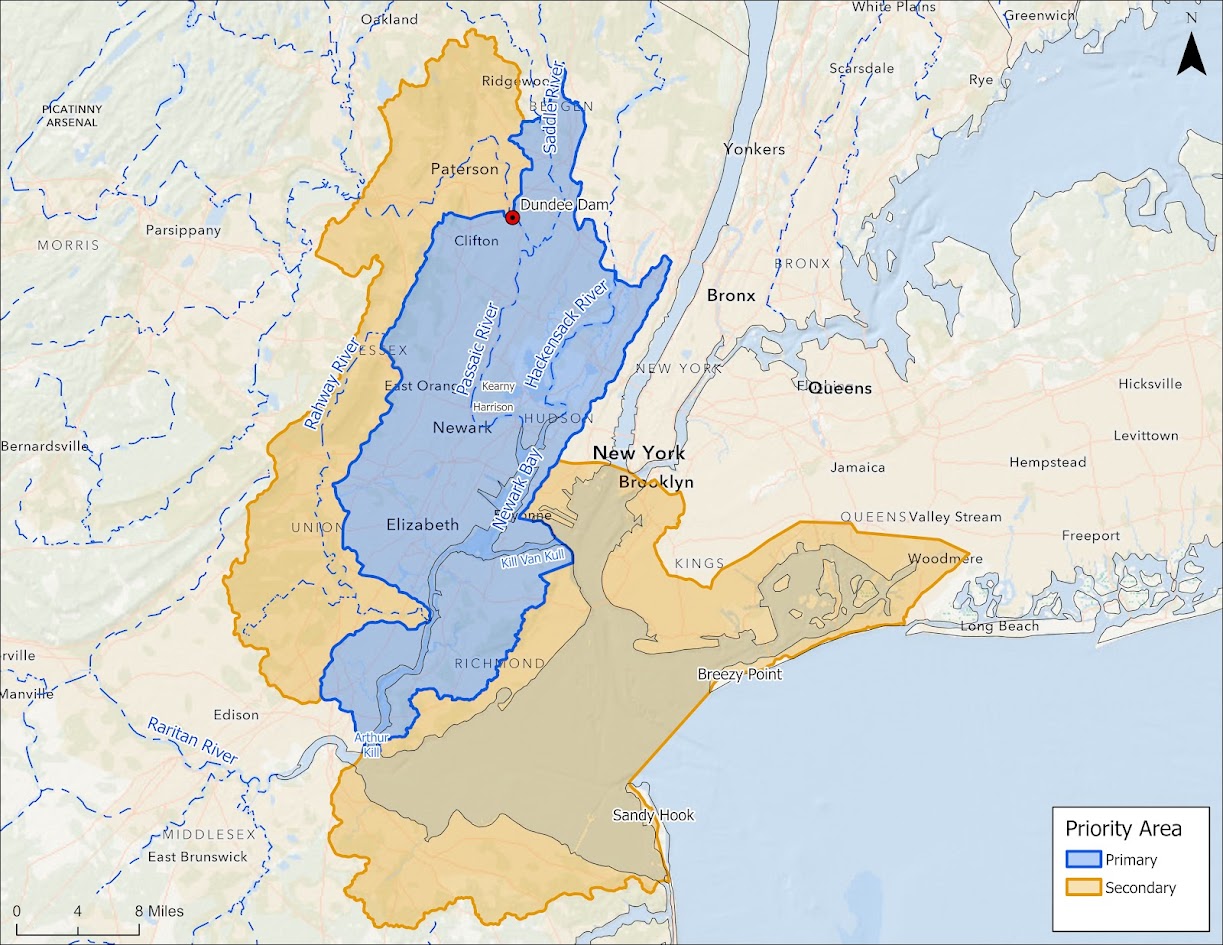
The Federal Trustees will evaluate projects using the criteria listed in the Submission Evaluation section (below) such as the benefits provided and the proximity to the potentially injured resources. Primary preference will be given to projects in the Lower Passaic River, Lower Hackensack River, Newark Bay, Arthur Kill, Kill van Kull, and their watersheds with a close geographic nexus to the resources potentially injured by releases related to the Diamond Alkali Superfund Site. Secondary priority will be given to projects within the NY-NJ Harbor Estuary. Projects in other tidal watersheds of adjacent regions may be considered if it is demonstrated that they have a close nexus to the injury for the Site and benefit those potentially injured resources (e.g., migratory species).
Geographical Project Boundaries
The Federal Trustees will review your submission as part of the development of a draft restoration plan. The draft plan will be made available for public review and comment.
Submission Guidelines
Please note that your project suggestion and any associated attachments may be posted online. Posting of project submissions is for informational purposes and does not indicate approval or acceptance by the Federal Trustees. The information you submit will be retained as part of the Administrative Record for the Diamond Alkali NRDAR.
The Trustees will consider many types of projects that benefit fish, wildlife, and supporting habitats within the watersheds of the lower Passaic River, the lower Hackensack River, Newark Bay, the Arthur Kill, and the Kill van Kull; particularly those that are tidally influenced. These include, but are not limited to:
- Preserving, enhancing, or restoring riparian and wetland habitats
- Streambank restoration and increasing floodplain habitat areas
- Removing barriers to fish passage in streams (e.g., dams, undersized culverts)
- Enhancing native plant species and controlling invasive species
- Restoring habitat that also benefits recreational uses like fishing or wildlife viewing
- Instream habitat restoration (e.g., adding natural structure, reducing channelization)
- Restoration of shellfish and their habitats
- Restoration of submerged aquatic vegetation (e.g., eelgrass)
- Land acquisition, particularly if it is associated with protection and restoration of coastal estuarine habitat
Types of restoration that will not be considered include:
- Projects that do not benefit potentially injured resources or lost services
- Projects that do not restore natural ecosystem processes (e.g., preferential use of hard armoring over soft engineering technology)
- Projects that are otherwise required (e.g., by statute, regulation, or court-order)
View submitted projects that meet our posting guidelines.
After you’ve successfully submitted your information, you’ll receive a confirmation number. It is important to retain that number for your records. The due date for submitting your project ideas is Sunday, May 17, 2026.
Only one attachment can be provided through the portal with a maximum size of 20 MB. Please email nmfs.lowerpassaicnewarkbay@noaa.gov if you have questions. Be sure to reference your project’s name and confirmation number in your email and subject line.
Please note: This is a generic form and includes some project types that are not accepted. Disregard those options and follow the project types listed in the guidelines. If you do not see an exact match, select the option that is closest to your request.
If you are having problems with the online portal, you may instead request a project idea submission form (in PDF) by emailing nmfs.lowerpassaicnewarkbay@noaa.gov. Once the form is completed, it can be sent to the same email address or mailed to:
- U.S. Fish and Wildlife Service
Attn: Ryan Braham
4 E. Jimmie Leeds Road
Galloway, New Jersey 08205
The Federal Trustees will screen each project submission in advance of being posted online. All projects and attachments will be reviewed based on the guidelines listed below and posted (or not) following that review. A project suggestion that contains unacceptable content will not be edited; those projects will simply not be posted and individuals will be notified. Your project suggestion including your name and contact information, if included, may be made publicly available.
Supporting documents, links, and similar content, pertinent to the project suggestion, are welcome. The appearance of external links, advertisements, political opinions, or other comments do not constitute endorsement by the U.S. Government.
Content will be screened and will NOT be posted if it:
- Contains vulgar language or material, personal attacks of any kind, threats, obscenity, or offensive terms
- Promotes services or products (non-commercial links that are relevant to the project are acceptable)
- Is far off-topic (i.e.,does not pertain to restoration of resources)
- Makes accusations
Submission Evaluation
When selecting the alternative to pursue, the Federal Trustees evaluate each of the possible alternatives based on all relevant considerations, including the following factors provided in the CERCLA regulations, 43 CFR 11.82(d):
- Technical feasibility
- The relationship of the expected costs of the proposed actions to the expected benefits from the restoration, rehabilitation, replacement, and/or acquisition of equivalent resources
- Cost-effectiveness
- The results of any actual or planned response actions
- Potential for additional injury resulting from the proposed actions, including long-term and indirect impacts, to the injured resources or other resources
- The natural recovery period
- Ability of the resources to recover with or without alternative actions
- Potential effects of the action on human health and safety
- Consistency with relevant federal, state, and tribal policies
- Compliance with applicable federal, state, and tribal laws
The Federal Trustees will consider other factors while evaluating project ideas that include:
- Nexus (connection) to injured resources
- Whether or not the proposed project is otherwise required to be conducted
- Site ownership and access
- The location relative to the Superfund site
- Benefits to species of concern, sensitive habitats
- Proximity to lands with protected status
- Benefits to multiple resources or services
- Ability of a project to leverage other funds
- Risk of recontamination
The Submission Period is Closed


