
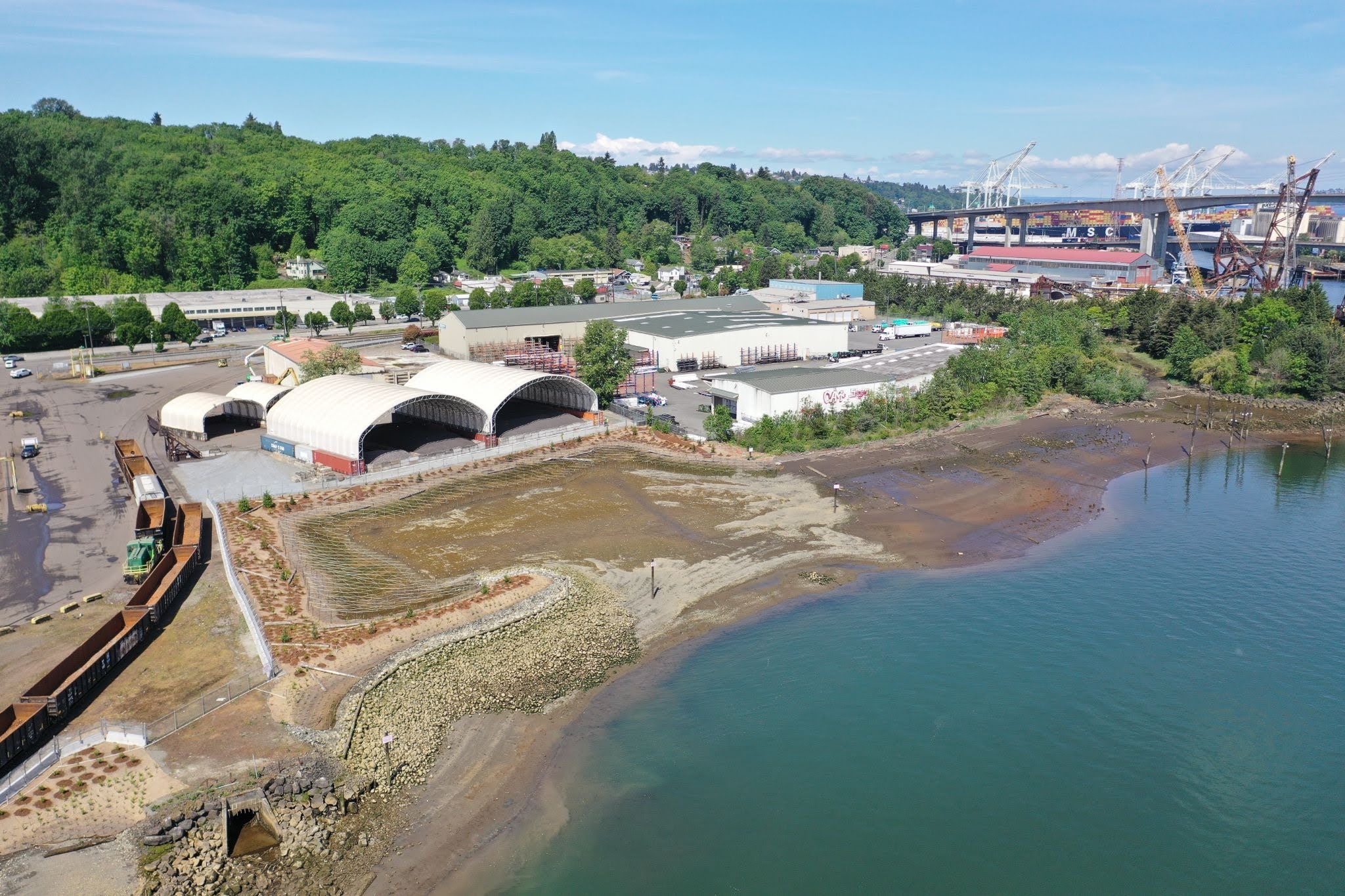
General Recycling Project Complete: Fish and Wildlife Habitat Restored in the Lower Duwamish River in Seattle, Washington
September 22, 2026
Along one of the most industrial stretches of Seattle’s Lower Duwamish River, nearly three acres of new habitat are now open to fish and wildlife. This summer, General Recycling of Washington (General Recycling) completed construction of a 2.8-acre restoration project along the Lower Duwamish River to restore habitat for Chinook salmon, shorebirds, and other wildlife. They created off-channel marsh, intertidal, and riverbank habitats which will help support the recovery of these natural resources harmed by decades of contamination in this industrial waterway.
The newly-created habitat will take years to fully establish, but fish have already been observed using this site.
Habitat is particularly valuable in this part of the Lower Duwamish River. Once a wide, meandering river and estuary, the Lower Duwamish River was straightened and filled as Seattle’s industrial waterfront developed. By the 1940s, approximately 97 percent of its original habitat had been lost. That makes shallow-water marsh, mudflat, and off-channel habitat especially important for juvenile salmon migrating through the river.
Building New Habitat
This project is part of a July 2024 settlement for natural resource damages between members of the Elliott Bay Trustee Council and General Recycling and its two affiliates. The settlement, valued at more than $23 million, resolves claims for natural resource injuries caused by the release of hazardous substances in the Lower Duwamish River. On behalf of General Recycling, the habitat project was designed by Floyd|Snider, KPFF Consulting Engineers, and JA Brennan Associates, and constructed by Orion Marine Contractors.
Creating the new habitat required reshaping this stretch of shoreline. As part of the project, General Recycling:
- Excavated and disposed of 7,215 cubic yards of contaminated soil in an approved upland facility
- Removed 390 linear feet of hardened shoreline, 96 creosote-treated pilings, and other shoreline debris
- Regraded and planted the site to create 2.2 acres of new, on and off-channel marsh, intertidal, and riparian habitat
- Protected an additional 0.6 acres of subtidal habitat on and adjacent to the Lower Duwamish River
Supporting Habitat for the Long Term
Construction may be finished, but the habitat is just beginning to develop. Over the next 10 years, marsh and riverbank vegetation will grow and reestablish, while small organisms like worms will colonize the off-channel mudflat. Those organisms, in turn, provide food for migrating salmon, birds, and other wildlife.
The settlement agreement also requires General Recycling to perform ten years of active maintenance and monitoring to ensure habitat establishment. After this ten-year period, General Recycling will continue to perform maintenance and stewardship of the site for another 20 years. The Trustees, with funds provided by General Recycling, will provide long-term stewardship of the site starting 30 years after construction.
This project is a major milestone for the Elliott Bay Trustee Council, a group of state and federal agencies and Tribes restoring Elliott Bay and the Lower Duwamish River. Members of the Elliott Bay Trustee Council include NOAA, the U.S. Department of the Interior, the Muckleshoot Indian Tribe, the Suquamish Indian Tribe of the Port Madison Reservation, and the State of Washington.
For more information and to stay in the know, sign up for DARRP’s Coastal Recovery News.


